Animarathon and Asimov’s

I skipped out on the Saturday afternoon session of this weekend’s Aikido seminar to go to Bowling Green with Aaron. We checked out the Animarathon for a short while, walked around campus, then got a coffee at Grounds.

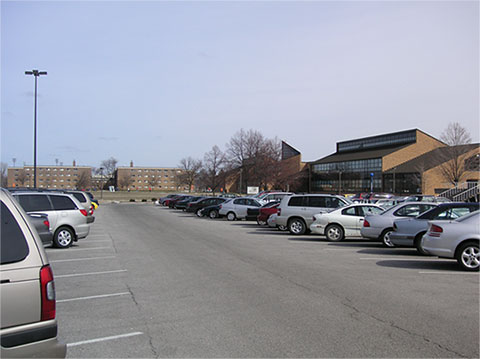
But first, an aside. BGSU alumni: take a look at this landscape and tell me what’s missing:

I’ll give you a hint: I’m standing in the parking lot by Jerome Library and Anderson Arena. On the left is Kreischer. On the right is the art building.

If you said the Saddlemire Student Services Building, give yourself a point! The old bookstore building was torn down late last year in preparation for a new Fine Arts building. It was unsettling to see a big empty dirt plot where the bookstore once stood. Almost as unsettling as walking around an anime convention inside Olscamp Hall, where I attended so many classes nearly a decade ago.

Grounds for Thought, however, is a more comfortable sort of familiar, as is the taste and smell of a single mocha and the feel of the heavy, tall glass mug in my hands. It feels like home, somehow.

A good part of the joy of Grounds — for me and mine, anyway — is perusing the used books. In particular, I like looking for new-to-me science fiction. And we hit the jackpot this time, when we saw an entire shelf of Asimov’s Science Fiction and Analog magazines. Aaron and I sat Indian-style on the floor in the middle of the aisle and scanned the table of contents for each one, looking for authors whose names we recognized. Our resultant haul:

  • Asimov’s, January 1985
    Including stories by Frederick Pohl, Connie Willis, et al.
  • Asimov’s, August 1986
    Including stories by Orson Scott Card, Harry Turtledove, et al.
  • Asimov’s, August 1989
    Including stories by Isaac Asimov, Orson Scott Card, et al.
  • Asimov’s, Mid-December 1989
    Including stories by Isaac Asimov, Connie Willis, Harry Turtledove, et al.
  • Asimov’s, February 1990
    Including stories by Bruce Sterling, et al.
  • Asimov’s, June 1990
    Including stories by James Patrick Kelly, Larry Niven, et al.
  • Asimov’s, November 1991 (double issue)
    Including stories by Isaac Asimov, Mike Resnick, Robert Silverberg, et al.
  • Asimov’s, November 1993
    Including stories by Frederick Pohl, Connie Willis, et al.
  • The Black Hole: The Illustrated Adaptation of the Exciting Film.
  • I, Jedi – A Star Wars novel by Michael A. Stackpole

After we got our coffee buzz and our sci-fi books, we went to Goodwill and found the Trivial Pursuit Pop Culture 2 DVD game (with questions we can answer! Yay!), then headed to the Woodland Small Mall to Steve and Barry’s, where Aaron and I got some geeky T-shirts.

I’m going to have plenty of short fiction to read for a while, and hopefully will discover some new sci-fi authors to follow. I’m looking forward to this…

links for 2008-03-29

Spring Challenge, Week #1

The short version: Both James and I lost one pound each this week, after a weekend of poor food choices and general culinary debauchery. That makes him down 0.4%, and me down 0.5%, just by virtue of our different starting weights.

The long version I’ll put after the jump, as it’s come to my attention that not everyone wants to hear the same diet and fitness crap week in and week out. Which is pretty much what it’s come to, isn’t it?
Continue reading

Hooray For Tax Returns

Funny, isn’t it, how something really spectacular — a vacation, or a great meal, or even just a fleeting feeling — can hang so heavily over the rest of your life? Nothing else will quite measure up to that moment of wondrousness, and it would be easy to spend the rest of one’s life searching for that elusive something that would match or exceed that one golden moment.

That’s the trap. When Shakyamuni Buddha postulated that life is suffering (dukkha), he also explained that part of this suffering is being stuck on the happy moments that fail to last. It’s not healthy to keep chasing after the next big thing.

That doesn’t stop us from trying, though. It doesn’t stop me from going to Red Lobster and ordering some expensive lobster tail, knowing full well that it won’t hold a candle to the whole steamed and stuffed lobster I had in Boston during our honeymoon in 2003. It doesn’t stop me from looking fondly at the memorabilia I bought and the photos I took during our week in Tokyo last year (note to self: still need to finish blogging that trip).

And it doesn’t stop us from planning new vacations with our tax return money.

Let’s segue now, shall we, from the realm of the spiritual to the realm of the worldly, and talk about things like TurboTax and NWAWorldVacations…
Continue reading

Making Do

Don’t worry ’bout your laundry
Forget about your job
Just crank up the volume
And yank off the knob

—Weird Al Yankovic, “UHF”

I know it’s not quite what Al had in mind, but whenever I think of this lyric, I’m reminded of the television my Mom and I had when I was in early high school.

It was a small color TV, maybe a 12-incher, circa 1982 (or before). This was the last TV we owned that had actual knobs to change channels, and a smaller knob below the channel selectors, labeled “Pull On / Vol.” This was how you turned on your television in the days before remotes, kiddies: grab the knob and pull. (Unless it was a twist-knob instead of a pull-knob, in which case you clicked it to the right to turn the TV on and then adjusted the volume, like the black-and-white TV we had when I was little. But I digress.)

The only problem was, by the time I was in high school — actually, long before that, now that I think about it — the power knob had made a break for it. All that was left was a small, black post with one flat side, barely protruding from a round hole in its wood-grain housing. To turn the TV off, we simply unplugged it. To adjust the volume, we carefully pinched the post with our fingertips and turned it, usually levering against the flat side of the post to make for easier and more precise adjustments. If we accidentally pushed the post back into its housing, into the “off” position, that meant getting the tweezers out of the bathroom and spending a few minutes way too long coaxing the post back out of its home.

Eventually, one of Mom’s boyfriends visited our apartment and was aghast at the outdated television we were watching. He bought us (among other things) a brand new twenty-some-inch newfangled TV with a remote, and we finally entered into the 1990s with the rest of society.

I think it’s funny, though, how I never really thought about how ghetto our old TV was. I mean, I didn’t really care that it wasn’t new or fancy; I was just glad that it served its purpose, like my bed (a frame salvaged from a discarded sleeper sofa) or my desk (an old sewing machine table).

We just made do with what we had.